The Simplicity Industrial Complex Took $340 From Me and I Have Never Owned More Stuff
Somewhere between my second "intentional living" webinar and my fourth grayscale phone case, it occurred to me that I had spent more money trying to own fewer things than I had ever spent simply owning things. This is the part where a smarter person would stop. I am not that person. I am the person who then bought a $34 linen pouch to store my minimalism supplies.
Let me walk you through exactly how this happened, with receipts, because I believe in transparency and also I need to justify this to myself in real time.
It Started Innocently, As All Financial Crimes Do
The ad found me on a Sunday. Instagram, obviously. A very calm man in a very beige room was explaining that technology had colonized my attention and that for $120, he could help me take it back. He had no visible clutter. His desk had one plant and one glass of water. I was sitting under a pile of seventeen browser tabs and a half-eaten bag of Trader Joe's pita chips, and I thought: yes. This man has something I need. I paid before I finished the ad.
The course was twelve modules. Module one was about identifying your "digital load," which is a phrase that made me feel like a broken appliance, which, fair. Module two recommended I purchase a dedicated distraction-free writing device — a small keyboard-only gadget that retails for $169 — so that I would stop writing on my laptop, which was, and I cannot stress this enough, working fine.
I bought the distraction-free writing device. I have used it twice. It lives in the linen pouch.
The Upsell Is the Product
Here is what nobody tells you about the digital minimalism content economy: it is an economy. A robust, thriving, extremely well-monetized one. The course instructor had a merch store. He sold a paper planner "designed for analog thinkers in a digital world" for $42. He sold a browser extension that blocks distracting websites for $8 a month, which you install on the laptop you were supposed to stop using. He sold a companion course, "Minimalism for Your Physical Space," for an additional $89, which I did not buy immediately but did buy three weeks later after a particularly bad Tuesday.
By the end of module four, I had been gently encouraged to acquire: the writing device, the planner, the browser extension, a "focus timer" that is a physical cube you flip to different sides to indicate what task you're doing (this is $27 and I have no explanation for why I own it), and a grayscale wallpaper pack for my phone. The wallpaper pack was free, which felt like a trap, and was.
The App That Monitors Your App Usage, a Horror Story
Module seven introduced me to a category of software I did not know existed: apps that track how much time you spend on other apps, so you can feel bad about it with greater precision. I downloaded four of them. One cost $49 per year. It sends me a weekly report that ranks my most-used applications in a format that genuinely resembles a performance review, and every Sunday I open it and it tells me I spent eleven hours on my phone and I close it and spend another forty minutes on my phone reading articles about digital wellness.
The irony is not lost on me. The irony has moved into my apartment and is eating my food.
I also own, at this point: a separate tablet I purchased specifically to read books on, because the course said reading on your phone "contaminates the reading experience with notification anxiety." The tablet cost $230. I have read one book on it. I read the other fourteen books I've finished this year on my phone, like a person who has not spent $230 on a tablet.
Simplicity Requires a Lot of Infrastructure
The wildest thing about the minimalism content pipeline is how much stuff it needs you to own to function. There's the physical planner for analog productivity, the digital calendar that syncs with the planner, the app that reminds you to check the physical planner, the second phone you use in grayscale to reduce dopamine hits, and the original phone you still use for everything because the grayscale second phone is annoying. There's the blue light glasses, the blue light screen protector, and the blue light blocking app, all of which are solving the same problem in escalating price brackets.
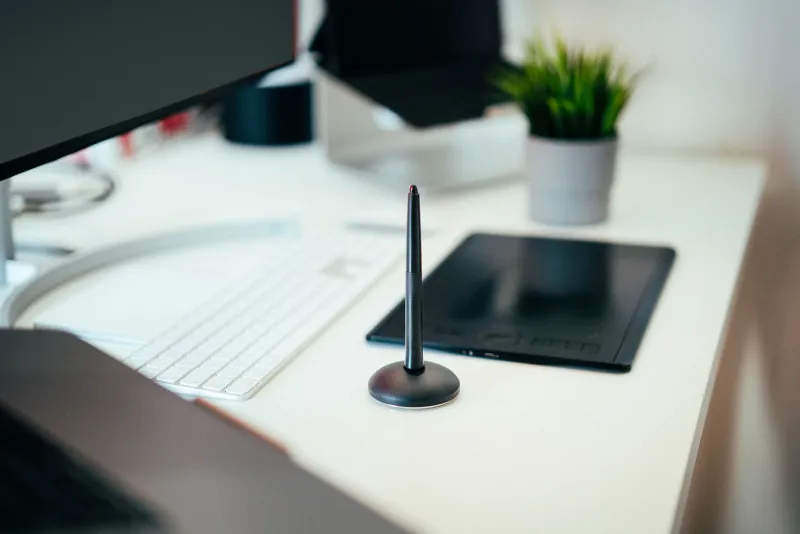
At some point I had a small shelf dedicated entirely to my simplicity infrastructure. I looked at it one morning with genuine pride before realizing that I had built a shrine to the concept of not building shrines to things.
The Community Was the Real Upsell
For an extra $15 a month, the course offered access to a private Discord server where other students discussed their minimalism journeys. I joined. There were 4,000 members. They were extremely active. Multiple people were posting seventeen times a day about owning fewer things. The irony was a living organism at this point, breathing, thriving, probably monetizing its own newsletter.
Someone in the server recommended a $200 "dumb phone" — a device with no internet, no apps, just calls and texts — as a way to reclaim presence. Fourteen people replied with purchase confirmation screenshots within the hour. I did not buy the dumb phone. I added it to a cart and then closed the tab, which I am counting as a personal victory and a sign of significant character growth.
What I Actually Learned, Which Is Bleak
The digital minimalism content economy is not selling you simplicity. It is selling you the feeling of taking action toward simplicity, which is an entirely different and significantly more expensive product. Every gadget, course, app, and planner is a transaction that lets you feel like you're solving the problem without actually changing the behavior that created the problem, which is that you buy things when you feel bad and then feel bad about buying things.
The course instructor, to his credit, is very good at his job. His room is still very beige. He has since launched a podcast, a second course, a physical journal, a digital journal, and a live retreat in Portugal for $1,800 that promises to help you disconnect. I have not registered for the retreat. I have looked at the registration page four times.
I currently own seven devices that I purchased in service of owning fewer devices. They are organized very neatly. The linen pouch really does look nice on the shelf.
I think I need another course.