We Spent Two Weeks Doing Influencer Life Hacks So You Could Watch Us Suffer Scientifically
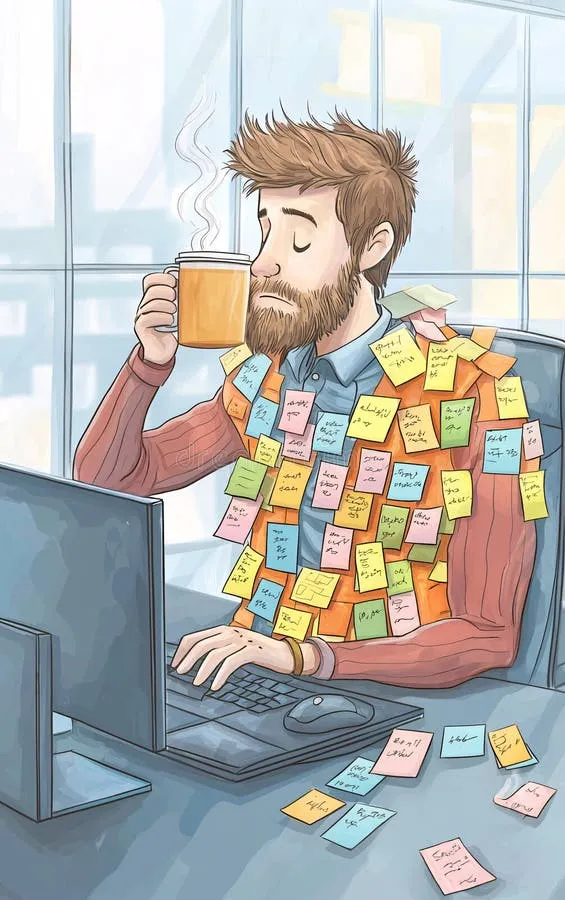
Photo: person overwhelmed sticky notes productivity tips laptop coffee morning routine, via thumbs.dreamstime.com
This is a science article. We want to be clear about that upfront. We used a spreadsheet. We had a methodology. The methodology was: do the thing the influencer said, observe what happens, write it down in the spreadsheet, question every choice that led us here. This is rigorous. This is journalism. This is also the most we've committed to anything since we signed up for a gym membership in January 2023 and went twice.
For fourteen days, we field-tested the most aggressively shared life hacks and productivity rituals currently circulating across TikTok, Instagram Reels, and whatever the YouTube equivalent of a fever dream is called. We went in with open minds and came out with a profound new understanding of why the self-help industrial complex is worth $43 billion annually and produces, as its primary output, more content about self-help.
Here is what we found.
Hack #1: The 4 AM Wake-Up ("Beat the World, Own the Day")
The Claim: Waking up between 4 and 5 AM gives you "stolen hours" before the chaos begins, allowing you to exercise, journal, meditate, prep your meals, cold plunge, read fifteen pages of a nonfiction book, and still arrive at work looking like a person who has their life together.
What Actually Happened: We woke up at 4:47 AM on day one because one influencer was very specific that 4:47 was optimal for cortisol rhythms, and we respected the bit. We then sat in our kitchen in the dark for twenty-five minutes eating cereal and watching our phone because there was nothing else to do at 4:47 AM except exist and regret. We did this for four days. On day five, we slept through our alarm and woke up at 8:15 AM feeling better than we had all week.
Verdict: The "5 AM Club" content genre exists because waking up early feels productive in a way that can be filmed. The sunrise looks good on camera. The empty gym looks aspirational. Whether or not you actually accomplish anything in those hours is a secondary concern to whether the content communicates that you are a Person Who Wakes Up Early, which is apparently a personality now.
Sleep scientists — again, real ones — consistently find that sleep deprivation impairs cognitive function, emotional regulation, and decision-making. There is no cortisol window. There is only the window where you could have slept another two hours.
Hack #2: Color-Coding Your Refrigerator by Food Group
The Claim: Organizing your fridge by color and food category using clear bins, labeled sections, and a consistent system will reduce food waste, save money, improve your diet, and make you feel calmer every time you open the refrigerator door.
What Actually Happened: We spent $67 on clear bins from Amazon. We spent approximately ninety minutes reorganizing our refrigerator into a system that looked genuinely incredible and very much like a lifestyle brand's content shoot. We took a photo. We sent the photo to three people. We felt good about the photo for about four hours.
By day four, the system had collapsed because we bought groceries without consulting the system, because that is how buying groceries works. The clear bins were now full of a chaotic mixture of leftovers, condiments, and a bell pepper we'd forgotten existed. The labeling system was technically still in place but now described contents it no longer contained. The refrigerator looked worse than before the intervention because now the chaos had infrastructure.
Verdict: Fridge organization content is not about your fridge. It is about the video of your fridge. The video of your fridge looks like control. Control looks like peace. Peace is the product being sold. Your actual refrigerator will be fine however you keep it, as long as you eat the leftovers within four days, which you won't, and that's not a system problem, that's a you problem, and no bin will fix it.
Hack #3: The "Optimal Morning Routine" (Estimated Time: 3 Hours and 17 Minutes)
The Claim: The ideal morning routine includes: no phone for the first hour, ten minutes of journaling, twenty minutes of meditation, thirty to forty-five minutes of exercise, a cold shower, a "mindful" breakfast (not eaten while standing over the sink, apparently), and fifteen minutes of "intention setting" before beginning work.
What Actually Happened: We calculated that executing this routine in full, before a 9 AM start time, requires waking up at approximately 5:43 AM. We attempted it twice. Both times, the "no phone for the first hour" rule collapsed within eight minutes because our phone is also our alarm clock and once it's in your hand it's in your hand, and that's just physics. The cold shower portion was abandoned permanently after day one. The journaling produced two entries that read, respectively, "I am very tired" and "Why."
Verdict: The optimal morning routine is a content format, not a wellness protocol. It takes the genuine finding — that consistent morning habits can improve focus and mood — and inflates it into a three-hour production that is only achievable if your morning routine is your job, which, for the influencers selling it, it literally is. They are filming their morning routine. The morning routine is content. You are the audience. The product is the feeling that you could also have this, if you just committed harder.
Why Our Brains Keep Falling For This
Here's the thing: we knew, going in, that most of these hacks were going to be nonsense. We have access to the same basic information about sleep and habit formation and cognitive science that anyone with a library card has access to. And we still did the 4:47 AM wake-up. We still bought the bins.
This is because life hacks are not actually about efficiency. They are about the feeling of agency in a world that frequently makes us feel like we have none. When your job is chaotic and your finances are stressful and the news is a relentless horror carousel, the idea that you could fix this by organizing your refrigerator is enormously appealing. It's a problem with a solution. The solution is purchasable. The purchase is immediate. The dopamine is real, even if the results aren't.
Researchers at the University of Chicago found that people are significantly more likely to adopt a new productivity habit when they're already feeling overwhelmed — not because they have more capacity, but because the habit feels like control. The life hack content ecosystem has reverse-engineered this finding and turned it into a business model. Make people feel overwhelmed (easy; see: everything), then sell them a system that promises relief.
The average American spends an estimated 2.5 hours per week consuming productivity and self-improvement content. That's 130 hours a year. Spent watching content about how to use your time better. The math here is doing something funny.
The One Hack That Actually Worked
We're going to be honest with you, because we respect you and also because this article needs a conclusion: there was one thing in our two-week experiment that produced a genuine, measurable improvement in daily function. It was not a hack. It was not a system. It was writing down three things we needed to do that day on a physical piece of paper and then doing them.
A pen. Paper. Three things. This technology is approximately 5,000 years old and requires no bins, no 4 AM alarm, no cold plunge, and no content creation to validate.
You're welcome. We suffered for this. The spreadsheet was real.