The Beige Abyss: How We Spent a Fortune Achieving the Look of Having Nothing
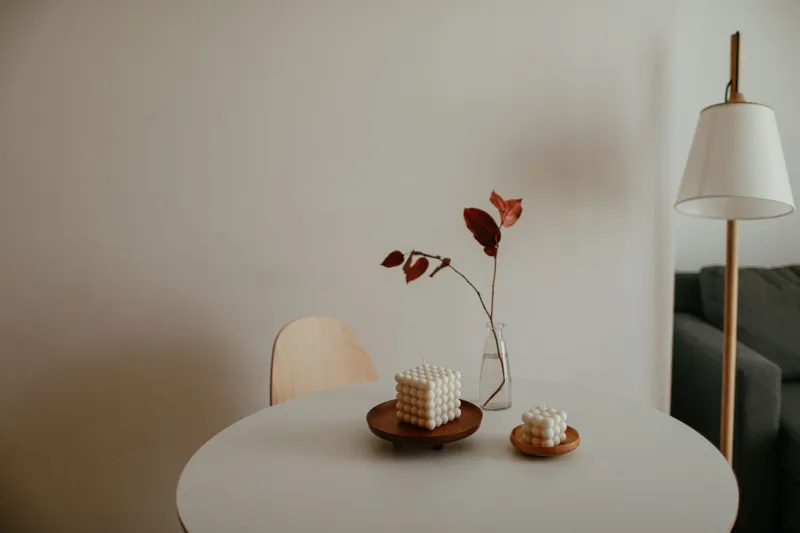
Somewhere between my third linen throw pillow and my second artisanal wooden tray — the one specifically designed to hold the other wooden tray — I had a revelation. I had spent approximately $2,800 in the past six months chasing a lifestyle whose entire ideological premise was spending less money on fewer things. My apartment looked like a Restoration Hardware catalog had a spiritual awakening and then immediately filed for bankruptcy. Everything matched. Nothing sparked joy in any authentic sense. And I was, financially speaking, cooked.
This is the story of minimalism in America. And it is, without question, the funniest long con the consumer economy has ever pulled off.
The Philosophy Was Free. The Aesthetic Cost Us Everything.
Let's establish the origin story quickly, because the irony deserves its own moment of silence. Marie Kondo wrote a book. The book said: get rid of things that don't spark joy. Simple. Elegant. Free, if you borrowed the book from a library, which none of us did because we bought the hardcover and the journal and the folding guide and the branded storage boxes.
From there, the minimalism-industrial complex did what the American consumer economy always does: it identified a values-based movement, stripped it of its values, and replaced them with SKUs. Suddenly, the path to owning less required owning better. More curated. More intentional. More expensive in a way that whispered rather than shouted.
The succulents appeared first. Then the $45 amber glass soap dispensers. Then the $160 jute rugs. Then the neutral-toned everything — the oat, the sand, the greige, the warm white that is somehow different from regular white in a way that costs $80 more per gallon of paint.
We were told we were decluttering. We were, in fact, just rotating inventory.
An Honest Accounting of the Damage
For the purposes of this investigation, we pooled receipts from four contributors who had all, at various points in the last two years, described themselves as "really getting into minimalism." The numbers are not good.
The Wooden Organizer Phase claimed an average of $340 per person. These are objects whose entire purpose is to organize the other objects you were supposed to have already gotten rid of. A $220 bamboo desk caddy to hold the three pens you kept. A $90 acacia wood tray to corral the candles that replaced your previous candles, which were too maximalist.
The Textile Situation ran approximately $600 per household. Linen duvet covers. Waffle-weave towels. Throw blankets in colors named after geological formations — "Slate," "Dune," "Quarry." One contributor owned four throw blankets. She described herself as a minimalist without blinking.
The Vessel Era — a period during which everyone apparently needed multiple empty vessels — cost us a collective $280. Ceramic bowls. Wabi-sabi pots. A $75 vase that existed, functionally, to hold a single dried pampas grass stem that cost $40. The vessel holds nothing. The vessel is the point. The vessel has made us feel things we cannot explain.
The Succulent Industrial Complex deserves its own federal investigation. These plants are marketed as low-maintenance symbols of intentional living. They are also $18 each, require specific soil that costs $22 a bag, and roughly 60% of them are dead within four months because it turns out "low maintenance" and "no maintenance" are different things, a distinction we learned too late.
Grand total across contributors: just north of $3,100. For the aesthetic of having less.
The Cognitive Dissonance Is the Product
Here's what the minimalism content pipeline figured out before we did: the tension between the ideology and the consumption is not a bug. It is the engine.
You feel vaguely bad about having too much stuff. You watch a YouTube video of a woman explaining how she owns 47 items total and has never been happier. You feel inspired. You feel also, immediately, the need to acquire the correct 47 items. You go to a website. The website has very clean design and lots of white space and the copy uses words like "intentional" and "considered" and "slow." You buy a $180 linen apron. You feel better. You feel worse. You watch another video.
This is not an accident. The minimalist aesthetic is the most effective marketing framework the wellness-adjacent economy has ever developed, because it pre-loads the purchase with virtue. You're not buying more stuff. You're buying the right stuff. You're investing in quality over quantity. You're doing the work. You have a $95 wooden dish brush and you are doing the work.
The actual minimalists — the people who own one mug and mean it — do not have Instagram accounts with 200,000 followers and a linked Amazon storefront. They are invisible to us because they cannot be monetized. The minimalism we consumed was always a costume.
What We Actually Have Now
Our apartments do look different. Calmer, in a way that photographs beautifully and feels, in person, slightly like a hotel room that doesn't have a TV. Everything is beige or the suggestion of beige. There are no sharp corners anywhere. We own at least two objects that exist solely to look like we thought carefully about what objects we own.
One of us still has 200 books she's not getting rid of, arranged behind a strategically placed linen curtain so the shelves don't read as "cluttered" in photos. Another reorganized his closet using the capsule wardrobe method and now owns fewer items of clothing, all of which cost more than his previous clothes, resulting in the same monthly spend with less outfit variety. A third bought a $300 minimalist desk lamp to replace a $40 lamp that worked fine, because the $40 lamp had too many buttons.
We are not living with less. We are living with less visible stuff and a higher debt-to-serenity ratio.
The Actual Move, For Free
If you genuinely want the minimalism experience without the financial self-destruction, here is the complete guide: stop buying things. Throw away or donate the things you already own that you don't use. Keep the $40 lamp. The succulents are a trap.
You will not feel the particular brand of curated peace that the aesthetic promises, because that peace was never real — it was a rendering. But you will have money, which is its own kind of freedom, and freedom does not require a $75 ceramic vessel to hold it.
We spent three thousand dollars learning this. You're welcome. The wooden tray is available for purchase if anyone wants it.